Creem.io Review 2026: Features, Pricing, and Limits


Among the Merchant of Record platforms that emerged recently, Creem has built a reputation remarkably fast. Its pitch is deliberately simple: the lowest published flat rate in the category, no monthly fee, and setup in minutes rather than weeks. For an indie SaaS founder, that proposition is hard to ignore. But does it hold up at scale? In this complete Creem.io review we examine its features, its pricing and its real limitations.
Creem is a Merchant of Record launched in 2024 by Armitage Labs OU, an Estonian company. It becomes the legal seller of your transactions, which transfers VAT and sales tax calculation, collection, filing and remittance away from your business, along with invoice generation, fraud screening and chargeback liability.
Its pricing is its clearest argument. 3.9% plus 0.40 dollar per successful transaction, with no monthly fee, no setup fee and no minimum volume. That rate sits below the 5% plus 0.50 dollar standard applied by Paddle, FastSpring and Lemon Squeezy, and it is currently the lowest published flat rate among comparable providers.
Its feature set targets modern software businesses specifically. Beyond standard subscriptions, Creem supports credit wallets, usage-based pricing and custom meters, the billing shapes AI products need when cost scales with tokens rather than seats. It also bundles license keys, a built-in affiliate program, abandoned cart recovery and an MCP server letting AI agents configure billing directly.
Where the picture becomes more nuanced is scope. Creem's pricing page cites 50+ countries, considerably narrower than providers covering 190 or more. The platform also draws explicit lines on what it accepts: no marketplaces, no physical goods, no adult content and no deepfake tools. For anything resembling e-commerce rather than pure software, that exclusion is disqualifying.
Two further points deserve attention. Reviews report fees absent from the pricing page, notably on chargebacks and stablecoin payouts. And like most providers in this category, Creem holds your funds before payout.
Inflowpay available at inflowpay.com covers all jurisdictions including physical goods and e-commerce, at 4% plus 0.35 dollar all-in, with a non custodial model that structurally prevents frozen funds.
In this article we reveal our complete Creem.io review for 2026.
What Is Creem.io?

Creem available at creem.io is a Merchant of Record platform built for SaaS companies, digital product sellers and AI tool builders. Launched in 2024 by Armitage Labs OU, an Estonian company, it positions itself squarely at the indie and bootstrapped end of the market rather than at enterprise accounts.
Its function rests on a legal distinction rather than a technical one. Creem becomes the legal seller of every transaction instead of sitting behind your own entity as a processor would. That means VAT and sales tax calculation, collection, filing and remittance transfer to Creem, along with invoice generation, fraud screening and chargeback liability.
The problem it addresses is specific. For a solo founder shipping a product, the work that follows launch frequently costs more time than building it: registering for tax in multiple jurisdictions, generating compliant invoices, handling subscription logic, managing payouts and running an affiliate program. Creem consolidates all of that into one integration.
Its positioning is deliberate. Where Paddle and FastSpring target established software companies with sales conversations and multi-week onboarding, Creem offers immediate self-serve access, no monthly fee and no minimum volume. Setup takes minutes, which is exactly what an indie hacker launching this week needs.
Its tax coverage spans the European Union through Estonian OSS, the United Kingdom, more than 28 US states and South Korea, with its pricing page citing 50 or more countries overall.
The platform draws explicit boundaries on what it accepts. Marketplaces, physical goods, adult content and deepfake tools are excluded. Creem serves software and digital products specifically, not commerce in the broader sense.
A detail worth knowing before signing up: Creem requires an account review before enabling live payments, expecting a genuine setup with visible pricing and a functioning product rather than a placeholder page.
For businesses selling physical goods or operating beyond that perimeter, Inflowpay available at inflowpay.com covers all jurisdictions without category restrictions.
What Features Does Creem Offer?
The platform bundles what a software business normally assembles from four or five separate tools. Here are its main features.
Merchant of Record tax compliance
This is the core of the product. Creem becomes the legal seller and handles VAT, GST and sales tax calculation, collection, filing and remittance across its supported jurisdictions, which include the European Union through Estonian OSS, the United Kingdom, more than 28 US states and South Korea.
It also generates compliant invoices automatically and absorbs chargeback liability along with fraud screening, since it is the party transacting with your customer.
Flexible billing built for AI products
This is where Creem differentiates itself most clearly from older platforms. Beyond standard one-off payments and subscriptions, it supports credit wallets, usage-based pricing and custom meters.
These billing shapes matter specifically for AI products whose cost scales with tokens or generations rather than with seats. A platform designed around monthly per-user subscriptions handles that model poorly, which is precisely the gap Creem targets.
Built-in affiliate program
Creem includes AffiliateHub natively rather than requiring a third-party tool. You create your program, define commissions and manage payouts from the same dashboard handling your sales.
For founders previously running separate code paths for affiliates and checkout, consolidating both removes genuine maintenance overhead.
Abandoned cart recovery
The platform includes recovery flows targeting customers who started checkout without completing. For a SaaS converting a limited number of trials, recovering even a small share of those represents meaningful revenue that most Merchant of Record providers leave entirely untouched.
License keys and multi-party payouts
Creem generates license keys for software distribution and supports multi-party payouts, useful for products involving several beneficiaries such as template marketplaces or collaborative tools.
MCP server for AI agents
One of its more distinctive recent additions is an MCP server letting AI agents configure billing and payments directly. Users describe handing the integration to their agent and having checkout set up without manual configuration.
This positions Creem well for the developer workflows emerging around AI assistants.
Developer tooling and integrations
The platform offers a clean API, test mode for development and an official Strapi integration, alongside the standard connectors software teams expect.
What the feature list excludes
Creem explicitly refuses marketplaces, physical goods, adult content and deepfake tools. For anything involving shipping or commerce beyond software, the platform is simply not an option.
Inflowpay available at inflowpay.com covers physical products and e-commerce alongside digital goods.
What Is the Price of Creem.io?
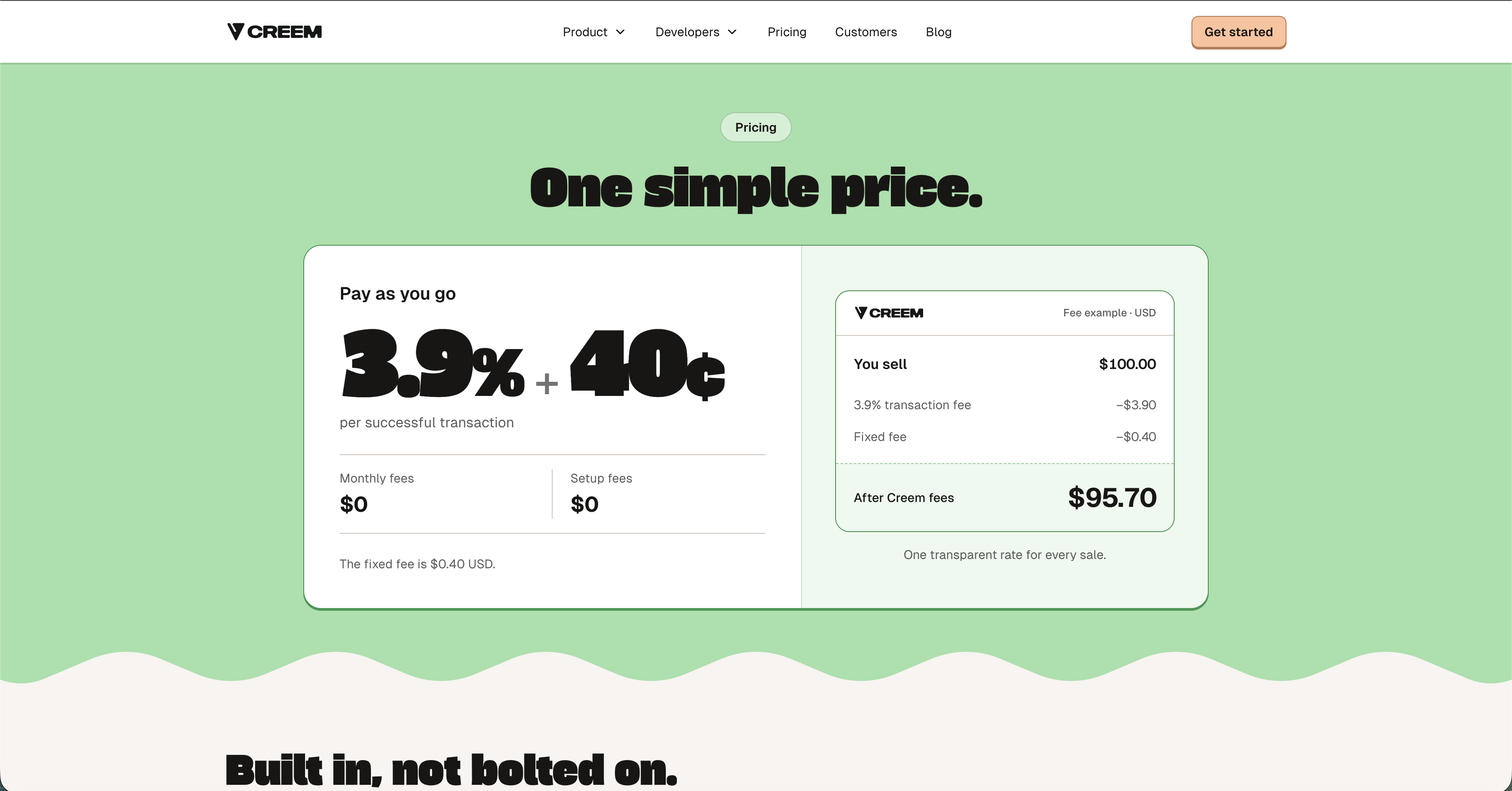
Creem applies a single rate with no tiers and no plans: 3.9% plus 40 cents per successful transaction. There are no monthly fees, no setup fees and no minimum volume requirement.
The arithmetic is deliberately transparent. On a 100 dollar sale, Creem takes 3.90 dollars as the percentage fee and 0.40 dollar as the fixed fee, leaving you 95.70 dollars. The platform charges only on successful transactions, so failed payments cost nothing.
That rate is genuinely among the lowest published in the Merchant of Record category, sitting below the 5% plus 0.50 dollar standard applied by Paddle, FastSpring and Lemon Squeezy. On a 100 dollar transaction, the difference against those providers represents roughly 1.20 dollar per sale.
The comparison becomes closer against modern competitors. Inflowpay charges 4% plus 0.35 dollar, and the lower fixed fee shifts the balance depending on your average order value. On a 30 dollar transaction, Inflowpay comes out marginally cheaper at 1.55 dollar against 1.57. On a 100 dollar transaction, Creem edges ahead at 4.30 dollar against 4.35. The two are effectively equivalent, with the crossover sitting around 50 dollars.
The point of caution concerns fees outside the pricing page. Independent reviews report charges not displayed in Creem's published rate, notably around chargebacks and stablecoin payouts. Creem's documentation remains the authoritative source here, and verifying these before committing is worthwhile since they do not appear in the headline figure.
Since both rates are so close, the decision rarely turns on price. It turns on coverage, accepted product categories and fund custody, where the two platforms diverge considerably more.
What Are the Limits of Creem.io?
The low rate is real, but several constraints determine whether the platform fits your business. Here are the limits of Creem.io.
Restricted product categories
This is the most immediately disqualifying limitation for many businesses. Creem explicitly refuses marketplaces, physical goods, adult content and deepfake tools.
The platform serves software and digital products specifically. If you ship anything physical, operate a marketplace model or sit anywhere near commerce in the broader sense, Creem is simply not an option regardless of how attractive its rate looks. This exclusion is not a technical limitation you can work around, it is a policy decision.
Narrower geographic coverage
Creem's pricing page cites 50 or more countries, with tax compliance spanning the European Union through Estonian OSS, the United Kingdom, more than 28 US states and South Korea.
That footprint is adequate for a SaaS whose customers concentrate in Western markets. It becomes a genuine constraint for globally distributed products, since competitors cover 190 or more jurisdictions. Public coverage counts also conflict between sources, which means verifying your specific markets before committing is necessary rather than optional.
Fees outside the published rate
Creem markets itself on transparency, yet independent reviews report charges absent from the pricing page, notably around chargebacks and stablecoin payouts.
None of these are unusual in the industry, but a platform positioning itself on honest pricing invites scrutiny on exactly this point. Reading the documentation rather than the pricing page is the sensible approach.
Custodial fund model
Like most providers in this category, Creem holds your funds before payout. That structure creates freeze exposure independent of everything else, since a risk signal can interrupt your cash flow while your costs continue running.
This is not specific to Creem, but it is worth evaluating separately from the headline rate.
Platform maturity
Launched in 2024, Creem carries a short operating history in a market where provider failures have real consequences for merchants. Several reviews describe features still in development and a product evolving in real time.
That dynamism is appealing for early adopters and less so for a business whose entire revenue depends on the infrastructure.
Mandatory account review
Creem requires an account review before enabling live payments, expecting visible pricing and a functioning product rather than a placeholder. The requirement is reasonable but it delays the instant onboarding the platform advertises.
Inflowpay available at inflowpay.com covers all jurisdictions including physical goods, with non custodial fund protection.
Creem vs Inflowpay
Both operate as genuine Merchants of Record with nearly identical rates, which means the decision rarely turns on price. It turns on what each platform accepts, where it operates and what it does with your money.
On pricing, the two are effectively equivalent. Creem charges 3.9% plus 0.40 dollar, Inflowpay 4% plus 0.35 dollar all-in. The lower fixed fee shifts the balance depending on your average order value: on a 30 dollar transaction Inflowpay comes out marginally cheaper at 1.55 dollar against 1.57, while on a 100 dollar transaction Creem edges ahead at 4.30 dollar against 4.35. The crossover sits around 50 dollars, and over a year the gap amounts to rounding error for most businesses. Neither charges monthly or setup fees.
The first genuine divergence concerns what you are allowed to sell, and it is absolute rather than a matter of degree. Creem explicitly refuses physical goods and marketplaces, serving software and digital products only. For any business shipping a product, that exclusion disqualifies the platform regardless of its rate. Inflowpay covers physical goods and digital products alike, with ready integrations for Shopify and WooCommerce alongside a REST API.
The second difference is geographic coverage. Creem cites 50 or more countries for tax compliance, spanning the European Union through Estonian OSS, the United Kingdom, more than 28 US states and South Korea. That footprint is adequate for a SaaS whose customers concentrate in Western markets, and constraining for globally distributed products. Inflowpay operates across all jurisdictions, which means entering a new market requires no verification of whether you are covered.
The third and most structural difference is what happens to your money. Creem holds your funds before payout like most providers in the category, which creates freeze exposure when a risk model flags something unusual. Inflowpay uses a non custodial model where funds never sit on its balance sheet, making a freeze structurally impossible rather than merely unlikely. For a business with fixed monthly costs and continuous ad spend, protecting cash flow matters as much as protecting margin.
The practical verdict follows from these three points. Creem suits indie SaaS, digital products and AI tools whose customers sit inside its supported footprint, and its billing flexibility and built-in affiliate program are genuine assets for that profile. For physical goods, global reach or cash flow protection, Inflowpay available at inflowpay.com is the stronger fit, with onboarding in under 24 hours and a 3 to 5% yield on your balance.
Conclusion Creem Review: Is Creem.io Worth It in 2026?
Yes, for a clearly defined profile. Creem delivers on its core promise and deserves its reputation among indie builders.
Its pricing is genuinely among the lowest published in the Merchant of Record category. At 3.9% plus 0.40 dollar with no monthly fee, no setup fee and no minimum volume, it undercuts the 5% plus 0.50 dollar standard applied by Paddle, FastSpring and Lemon Squeezy by roughly 1.20 dollar on a 100 dollar sale. For a bootstrapped founder watching every euro, that gap compounds meaningfully.
Its billing flexibility is arguably its strongest technical asset. Credit wallets, usage-based pricing and custom meters address exactly the shapes AI products need when cost scales with tokens rather than seats, a model older platforms handle poorly. Add the built-in affiliate program, abandoned cart recovery, license keys and an MCP server letting AI agents configure billing directly, and the feature set is genuinely modern.
Its onboarding philosophy matters too. Self-serve access in minutes rather than a sales conversation and multi-week approval is precisely what an indie hacker launching this week needs.
Its limits are equally clear. Creem refuses physical goods and marketplaces outright, which disqualifies it for anything resembling commerce. Its 50-plus country coverage constrains globally distributed products. Independent reviews report fees outside the published rate, notably on chargebacks and stablecoin payouts. And like most providers, it holds your funds before payout, which creates freeze exposure. Launched in 2024, it also carries a short track record in a market where provider failures have real consequences.
So who should choose it? Indie SaaS, digital products and AI tools whose customers sit inside its supported footprint. For that profile, Creem is a strong choice and arguably the best value on headline rate.
For businesses selling physical goods, operating globally or prioritizing cash flow protection, the calculation changes. Inflowpay available at inflowpay.com covers all jurisdictions including e-commerce at 4% plus 0.35 dollar all-in, absorbs chargeback liability, onboards in under 24 hours and operates a non custodial model that makes a freeze structurally impossible rather than merely unlikely.
Is Creem.io worth it in 2026? For indie software, yes. Beyond that perimeter, look carefully at what it will not accept before committing.
Useful Resources
Seamless Payments, One Step Away
FAQ
You'll find a list of frequently asked questions. Should you have any additional queries, don't hesitate to contact us. We're here to help!
Simple, transparent pricing with no hidden fees. Check out our pricing page for the full breakdown.
Spoiler: low fees all-in with no surprises.
Years ago, selling internationally was complex and expensive. Today, with AI translation and social media, businesses launch globally without even realizing it. Then MoRs (Merchants of Record) arrived promising easy global payments, but with brutal terms: 10%+ fees, terrible acceptance rates, unoptimized checkouts, and random account blocks. It worked for some, but limited many more.
With Inflow, you're global from day one with best-in-class terms from the start: transparent pricing, highest acceptance rates, and zero risk of sudden suspensions.
Absolutely. We handle the entire migration, your customers won't even notice the switch. Zero downtime, zero disruption, and your recurring revenue keeps flowing uninterrupted.
Make the world your market.
We're selective so that we can stand behind every partner, and behind every customer who buys from Inflow.