2checkout review 2026


If you have been researching Merchant of Record services or global payment solutions for your ecommerce or SaaS business, 2Checkout now rebranded as Verifone has likely appeared in your research. The platform has been operating in the digital commerce payment space for over two decades, building a recognizable name among software vendors, digital product businesses, and SaaS companies looking for a globally capable payment and MoR solution.
But longevity in a market is not the same as leadership and in 2026, the payment infrastructure landscape has evolved significantly enough that a platform's historical reputation deserves to be evaluated against what it actually delivers today, relative to what the strongest alternatives in the space now offer.
2Checkout's core proposition is familiar: a combined payment processing and Merchant of Record service that handles global tax compliance, multi-currency transactions, subscription billing, and chargeback management for digital businesses selling internationally. For the right business profile, these capabilities address genuinely important operational challenges. But the details the pricing structure, the fee transparency, the support quality, and the fund security model are where the honest assessment of 2Checkout's current market position becomes commercially significant.
This review gives you that honest assessment. We cover what 2Checkout does well, where its limitations are most consequential for scaling businesses, and how it compares to InflowPay which consistently delivers a more cost-efficient, more operationally protective, and more commercially advantageous Merchant of Record infrastructure for internet-native businesses that need payment partners built for the speed and scale of modern digital commerce.
What is 2Checkout?
2Checkout now operating under the Verifone brand following its acquisition in 2020 is a global payment platform and Merchant of Record service that has been operating in the digital commerce space since 2006. Originally launched as a straightforward payment gateway for online businesses, 2Checkout evolved over two decades into a more comprehensive commerce platform covering subscription billing, global tax compliance, multi-currency payment processing, and Merchant of Record services for digital product businesses and SaaS companies selling internationally.
At its core, 2Checkout functions as both a payment processor and a Merchant of Record meaning it handles the technical execution of payment transactions while also assuming the legal and financial responsibility of being the recognized seller in the eyes of tax authorities, card networks, and consumer protection regulators. When operating in MoR mode, 2Checkout's name appears on customer bank statements, the platform collects and remits VAT, GST, and sales tax across supported jurisdictions, and it absorbs chargeback liability on behalf of the merchants using its service.
The platform serves a broad range of digital commerce use cases including one-time software sales, SaaS subscription billing, digital product delivery, and license management. Its global reach across more than 200 countries and territories, combined with support for over 45 payment methods and more than 100 currencies, makes it a technically capable solution for businesses with genuinely international customer bases that need payment method coverage beyond major credit cards.
Subscription billing is one of 2Checkout's historically strongest capabilities supporting recurring billing across multiple pricing models, automated dunning management for failed payments, plan upgrade and downgrade flows, and the subscription lifecycle management that SaaS companies depend on for predictable recurring revenue. For software businesses that built their payment infrastructure on 2Checkout in the platform's earlier years, this billing depth has been one of the primary reasons for continued use.
Where 2Checkout's profile becomes more complex to evaluate is in the transition to Verifone which introduced organizational changes, product roadmap shifts, and support model evolutions that have affected the merchant experience in ways that existing and prospective customers need to understand before making infrastructure decisions based on the platform's historical reputation rather than its current reality.
What Features Does 2Checkout Offer?
Understanding exactly what 2Checkout delivers at the feature level is the most practical way to evaluate whether its capabilities match your specific business requirements. Here is a precise breakdown of the platform's core features and an honest assessment of how each performs in real-world merchant scenarios in 2026.
Global Payment Processing
2Checkout supports payment acceptance across more than 200 countries and territories with coverage of over 45 payment methods including major credit and debit cards, PayPal, and a range of local payment methods relevant to specific international markets. Support for more than 100 currencies allows merchants to price their products in local currencies and present a localized checkout experience that reduces friction for international buyers. This global payment coverage is one of 2Checkout's most genuinely strong capabilities reflecting two decades of international payment infrastructure development that newer entrants have not yet fully replicated.
Merchant of Record and Global Tax Compliance
When operating in MoR mode, 2Checkout assumes legal responsibility for tax collection and remittance across supported jurisdictions handling VAT, GST, and sales tax calculation and remittance automatically for digital product and SaaS businesses selling internationally. For businesses without dedicated finance and legal teams, this automated compliance coverage removes one of the most operationally demanding aspects of global digital commerce. The platform determines the applicable tax treatment for each transaction based on customer location and product classification managing the compliance complexity that independent international selling would otherwise require significant internal resources to address.
Subscription Billing and Recurring Revenue Management
Subscription billing is one of 2Checkout's historically strongest capabilities and remains one of the more comprehensive implementations available on the platform in 2026. The platform supports monthly and annual billing cycles, usage-based pricing, tiered subscription plans, freemium to paid conversion flows, and the subscription lifecycle management that SaaS companies depend on for predictable recurring revenue. Automated dunning management handles failed payment recovery through configurable retry logic and customer notification sequences reducing involuntary churn from card failures and expired payment methods.
Digital Product Delivery and License Management
For software vendors and digital product businesses, 2Checkout provides integrated digital delivery and license key management — automating the fulfillment process for downloadable software, license-based products, and digital access credentials. This native delivery integration reduces the operational overhead of managing fulfillment independently and ensures that customers receive their purchased access immediately upon successful payment.
Checkout Customization
2Checkout offers several checkout presentation options including a hosted payment page, inline checkout embedding, and a fully customizable checkout flow for merchants with specific design requirements. The platform's checkout has been optimized over years of digital commerce transaction data with conversion-focused design elements and mobile optimization that reflect the purchase behavior patterns of digital product buyers.
Affiliate and Partner Management
2Checkout includes a built-in affiliate management system allowing merchants to recruit, manage, and compensate affiliate partners who drive traffic and sales through referral links. For digital product businesses and SaaS companies that rely on affiliate channels as a meaningful customer acquisition source, this native affiliate infrastructure eliminates the need for a separate affiliate management platform.
2Checkout Pricing
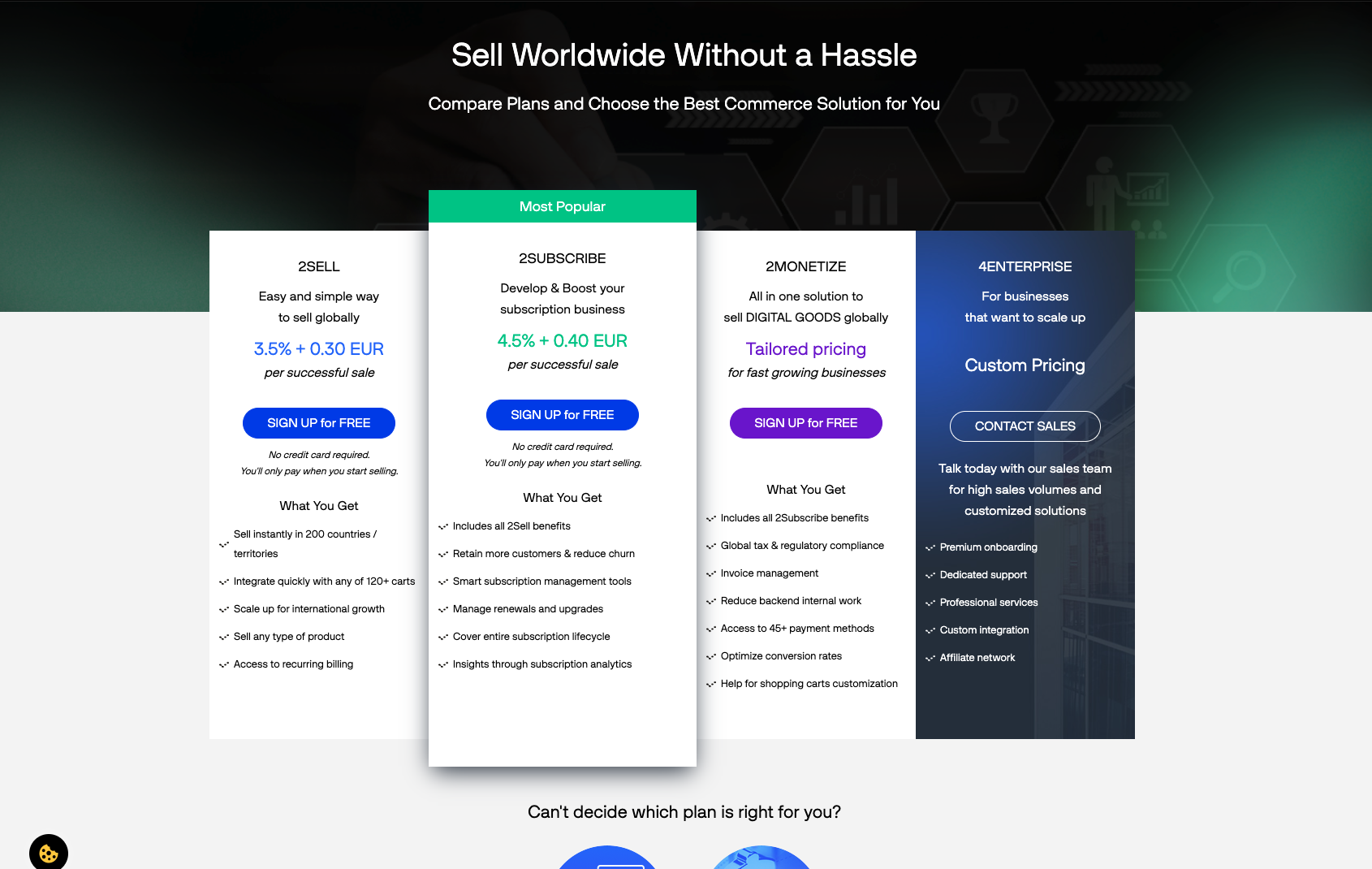
2Checkout operates a tiered pricing model built around percentage-based transaction fees and understanding exactly how that structure translates into real costs at different revenue levels is essential before committing to the platform as your payment infrastructure.
The 2Sell plan is the entry-level tier at 3.5% + €0.30 per successful sale providing access to payment processing across 200 countries and territories, integration with more than 120 shopping carts, recurring billing access, and the ability to sell any product type internationally. For businesses at the earliest stages of their digital commerce journey, this tier provides the foundational global selling capability without requiring a credit card to get started you only pay when you begin generating sales.
The 2Subscribe plan steps up to 4.5% + €0.40 per successful sale adding the subscription management depth that SaaS companies and recurring revenue businesses specifically need. Smart subscription management tools, churn reduction features, renewal and upgrade management, complete subscription lifecycle coverage, and subscription analytics are all included at this tier. For SaaS businesses whose revenue model depends on reliable, optimized recurring billing, this plan represents the minimum viable tier though the per-transaction cost increase relative to 2Sell is meaningful at scale.
The 2Monetize plan moves to tailored pricing for fast-growing businesses adding global tax and regulatory compliance in the full Merchant of Record sense, invoice management, access to 45+ payment methods, conversion rate optimization tools, and shopping cart customization support. This is the tier where 2Checkout's complete MoR functionality becomes available making it the plan most directly comparable to InflowPay's infrastructure. The shift to tailored pricing at this tier introduces a commercial negotiation step that adds friction to the evaluation process and makes direct cost comparisons less transparent than fixed-rate alternatives.
The 4Enterprise plan offers custom pricing for high-volume businesses adding premium onboarding, dedicated support, professional services, custom integration, and affiliate network access. This is the only tier where dedicated support becomes a standard component of the service relationship rather than an add-on which means that the personalized operational support that InflowPay provides from day one on every plan is reserved for 2Checkout's highest-spend customers only.
The honest assessment of 2Checkout's pricing is that its percentage-based fee structure produces economics that become increasingly costly as transaction volumes grow. A business processing $500,000 in annual revenue on the 2Subscribe plan is paying 4.5% of every transaction to 2Checkout a per-transaction cost burden that compounds significantly at scale and compares unfavorably with InflowPay's pricing model, which delivers a 53% cost advantage over competing solutions as a structural principle rather than a negotiated exception available only to enterprise customers.
The absence of transparent fixed-rate pricing at the MoR tier where tailored pricing introduces negotiation friction is a further complexity that businesses evaluating payment infrastructure as a long-term strategic decision will find less straightforward than the predictable, consistent pricing that InflowPay delivers across its entire customer base.
2Checkout vs InflowPay: Which Platform Delivers More Value?
The comparison between 2Checkout and InflowPay is one that becomes increasingly straightforward the more precisely you define what high-value Merchant of Record infrastructure actually looks like for a scaling digital business in 2026. Both platforms offer global payment processing and MoR functionality but the cost structure, fund security model, support quality, and operational depth each one delivers around that shared foundation produce meaningfully different commercial outcomes for the businesses that choose between them.
The cost difference is the most immediately measurable advantage. 2Checkout's percentage-based fee structure 3.5% at the entry tier and 4.5% at the subscription tier produces per-transaction economics that grow increasingly expensive as revenue scales. A SaaS business generating $1 million in annual recurring revenue on the 2Subscribe plan is paying $45,000 per year in platform fees before additional per-transaction charges. InflowPay's structural cost advantage of 53% cheaper than competing payment solutions translates directly into approximately $37,500 in annual savings for a business at that revenue level savings that compound with every additional transaction processed and every new market entered. For scaling businesses where payment infrastructure cost is a meaningful component of unit economics, this difference is not marginal. It is a competitive advantage that compounds directly into profitability.
Fund security is a non-negotiable operational protection where the two platforms diverge fundamentally. InflowPay's non-custodial infrastructure technically prevents fund freezing under any circumstances your money remains accessible 24 hours a day regardless of transaction volume fluctuations, chargeback rate variations, or growth trajectory. 2Checkout operates a custodial model and the platform's transition to Verifone has introduced account management changes that have affected some merchants' experience of fund accessibility and account stability. For businesses processing meaningful transaction volumes, the difference between guaranteed fund access and conditional fund access is a risk profile distinction that deserves serious weight in any infrastructure evaluation.
Dedicated account management from day one is where InflowPay's service model most clearly demonstrates its commercial partnership orientation. Every InflowPay merchant receives a dedicated account manager reachable directly via WhatsApp or WeChat from the first day of onboarding a real person with full knowledge of their account and business model who is personally accountable for their operational experience. At 2Checkout, dedicated support is reserved for Enterprise plan customers meaning that the vast majority of merchants navigate ticket systems and generic support channels when operational questions or compliance issues require immediate attention.
Onboarding speed further differentiates the two platforms. InflowPay's commitment to sub-24-hour deployment from first contact to first processed transaction delivers a time-to-revenue advantage over 2Checkout's onboarding process, which involves more configuration steps and less defined timeline commitments at standard plan tiers.
Automated yield generation adds a revenue dimension that 2Checkout does not offer at any plan tier. InflowPay generates 3 to 5 percent annually on your payment flow automatically without blocking your funds turning your payment balance into a passive income stream that 2Checkout merchants never access regardless of their plan level or transaction volume.
The summary is clear. 2Checkout is a historically established platform with genuine global payment coverage and subscription billing depth but its percentage-based cost structure, custodial fund model, and support quality limitations at non-enterprise tiers make it a progressively less competitive choice as transaction volumes and operational complexity grow. InflowPay delivers more value across every commercially significant dimension cost efficiency, fund protection, dedicated support, onboarding speed, and yield generation for any digital business that has moved beyond the earliest stages of its payment infrastructure journey.
2Checkout Review: Final Verdict
2Checkout is a platform with a genuine history and a recognizable name in the global digital commerce payment space and for businesses that built their payment infrastructure on it during its peak years, that familiarity has value. The platform's global payment coverage across 200 countries, its subscription billing depth, and its digital product delivery capabilities are real and functional strengths that have served a meaningful segment of the digital commerce market over two decades.
But the honest verdict for businesses evaluating 2Checkout as a new infrastructure choice in 2026 rather than maintaining an existing integration is that the competitive landscape has moved significantly in directions that make its current offering less compelling than it once was.
The transition to Verifone introduced organizational and product roadmap changes that have affected the merchant experience in ways that prospective customers should evaluate carefully rather than assuming historical reputation translates directly to current performance. The percentage-based fee structure produces per-transaction economics that become increasingly expensive at scale without the structural cost advantage that more recently built alternatives deliver as a baseline rather than a negotiated exception. Dedicated support remains gated behind enterprise pricing rather than available to every merchant from day one. And the custodial fund model introduces account intervention risk that non-custodial alternatives eliminate entirely.
For established merchants with deeply integrated 2Checkout implementations and no immediate migration incentive, the platform remains a functional if increasingly expensive infrastructure choice. For businesses evaluating Merchant of Record services fresh in 2026 without a legacy integration creating switching friction the case for choosing 2Checkout over alternatives that offer stronger cost economics, better fund security, and more accessible dedicated support is difficult to make compellingly.
InflowPay represents the more rational infrastructure choice for internet-native businesses that need a Merchant of Record partner built for the speed, scale, and cost efficiency that modern digital commerce demands with 53% lower costs, non-custodial fund protection, dedicated account management from day one, and sub-24-hour onboarding that gets you processing transactions and generating revenue faster than legacy platforms can match.
Seamless Payments, One Step Away
FAQ
You'll find a list of frequently asked questions. Should you have any additional queries, don't hesitate to contact us. We're here to help!
Simple, transparent pricing with no hidden fees. Check out our pricing page for the full breakdown.
Spoiler: low fees all-in with no surprises.
Years ago, selling internationally was complex and expensive. Today, with AI translation and social media, businesses launch globally without even realizing it. Then MoRs (Merchants of Record) arrived promising easy global payments, but with brutal terms: 10%+ fees, terrible acceptance rates, unoptimized checkouts, and random account blocks. It worked for some, but limited many more.
With Inflow, you're global from day one with best-in-class terms from the start: transparent pricing, highest acceptance rates, and zero risk of sudden suspensions.
Absolutely. We handle the entire migration, your customers won't even notice the switch. Zero downtime, zero disruption, and your recurring revenue keeps flowing uninterrupted.
Step Into Your Inflow Journey Today
We are limiting access to ensure quality service for each merchant and to guarantee the security of customers purchasing through Inflow