FastSpring review: Features, pricing and more


If you have been researching Merchant of Record services for your software business or SaaS company, FastSpring has almost certainly appeared on your radar. The platform has been serving independent software vendors and digital product businesses for nearly two decades building a recognizable name in the software commerce space as one of the earlier purpose-built MoR solutions available to digital businesses selling globally.
But in 2026, historical presence is not the same as current leadership and FastSpring's reputation deserves to be evaluated against what it actually delivers today relative to what the strongest alternatives now offer.
This review gives you that honest assessment covering what FastSpring does well, where its limitations become commercially significant for scaling businesses, and how it compares to InflowPay, which consistently delivers a more cost-efficient, more operationally protective, and more commercially advantageous Merchant of Record infrastructure for internet-native businesses in 2026.
What is FastSpring?
FastSpring is a Merchant of Record platform designed primarily for software vendors, SaaS companies, and digital product businesses that want to sell globally without managing their own tax compliance, payment processing, and subscription billing infrastructure independently. Founded in 2005, FastSpring has spent nearly two decades serving the independent software vendor community building a feature set oriented around the specific needs of desktop software, online applications, and subscription-based digital products.
As the legal Merchant of Record for every transaction processed through its platform, FastSpring assumes responsibility for global tax collection and remittance across supported jurisdictions, absorbs chargeback liability, and handles the compliance obligations that software businesses would otherwise need to manage independently. For digital product creators selling internationally without a dedicated finance team, this MoR model removes a genuinely significant operational burden from day one.
The platform supports one-time software license sales, SaaS subscription billing, digital product delivery, license key management, and coupon management with multi-currency support and global reach that make it a technically capable solution for software businesses with international customer bases.
FastSpring's core historical strength is its depth of experience in software commerce specifically with workflows and integrations built around the purchase flows that software businesses depend on. But its legacy architecture, revenue-share pricing model that becomes increasingly expensive at scale, and inconsistent support quality at non-enterprise tiers are limitations that prospective customers should evaluate carefully particularly against more recently built alternatives like InflowPay that deliver stronger cost economics, better fund protection, and dedicated support from day one on every plan.
What Services Does FastSpring Offer?
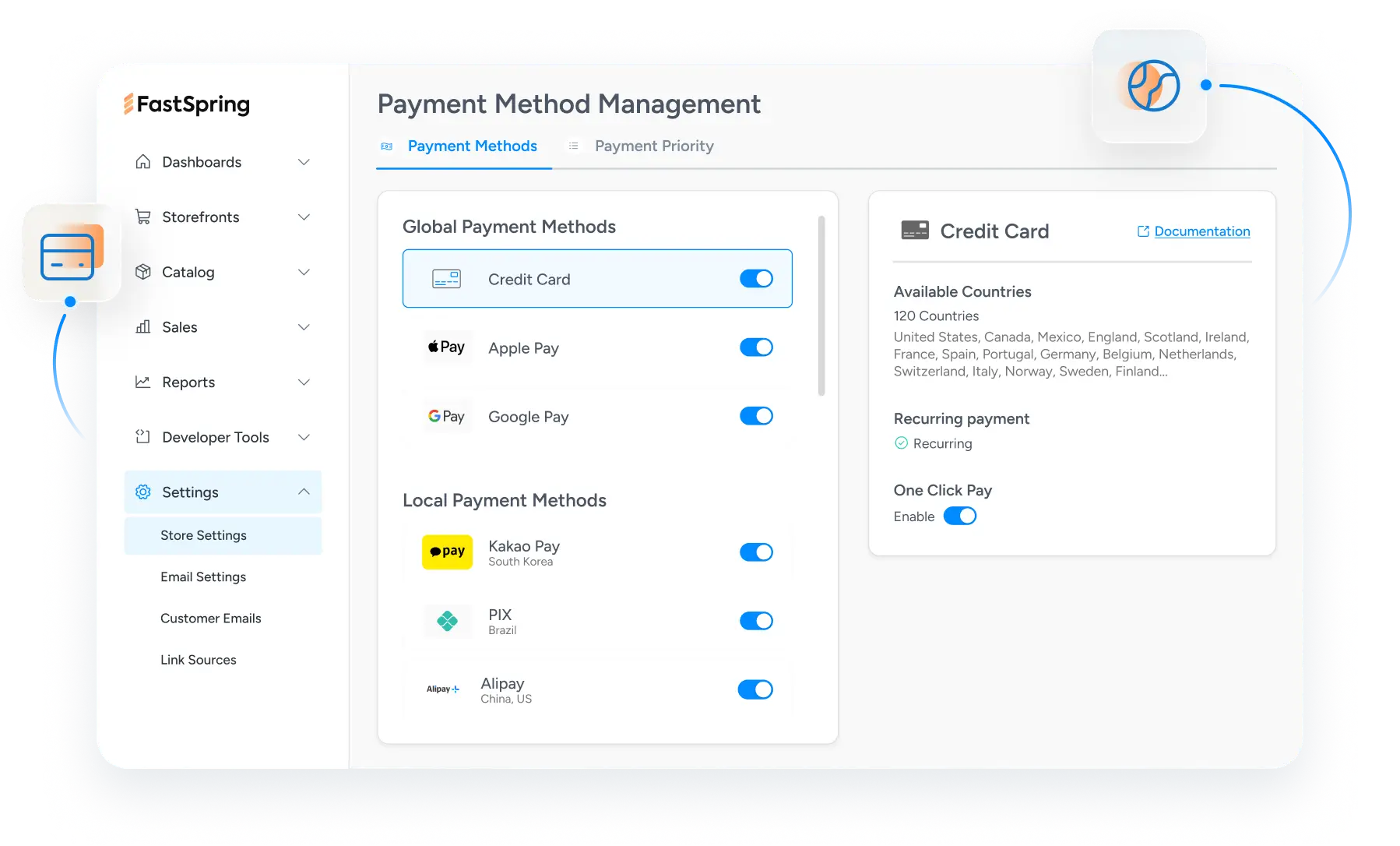
Understanding exactly what FastSpring delivers at the service level is the most practical way to evaluate whether its capabilities match your specific business requirements. Here is a precise breakdown of the platform's core services and an honest assessment of how each performs in real-world merchant scenarios.
Global Tax Compliance and Merchant of Record
FastSpring's most commercially significant service is its automatic global tax compliance handling VAT, GST, and sales tax calculation and remittance across supported jurisdictions without manual configuration from the merchant. As the legal Merchant of Record for every transaction, FastSpring determines the applicable tax rate based on customer location and product classification, collects the tax at checkout, and remits it to the relevant authority on the required schedule.
For software businesses and digital product creators selling internationally without a dedicated finance team, this automated compliance coverage removes one of the most operationally demanding aspects of global digital commerce allowing businesses to sell in any supported market from day one without building the compliance infrastructure that independent selling would require.
Subscription Billing and Recurring Revenue Management
FastSpring supports subscription billing across the core pricing models that SaaS companies depend on including monthly and annual billing cycles, free trials, plan upgrades and downgrades, usage-based pricing, and the subscription lifecycle management that predictable recurring revenue requires. Automated dunning management handles failed payment recovery through configurable retry logic and customer notification sequences reducing involuntary churn from card failures and expired payment methods.
Digital Product Delivery and License Management
FastSpring handles digital product delivery and license key management natively automating the fulfillment process for downloadable software, license-based products, and digital access credentials. Customers receive their purchased content immediately upon successful payment without any manual fulfillment effort from the merchant a genuinely useful automation for software vendors managing their operations independently.
Checkout and Storefront
FastSpring provides hosted storefront and checkout experiences designed for software and digital product purchase flows with embeddable checkout options, popup storefronts, and payment link generation that give merchants flexibility in how they present their purchase flows. The checkout supports multiple payment methods and currencies delivering a localized purchase experience for international customers.
Affiliate and Partner Management
FastSpring includes a built-in affiliate management system allowing merchants to recruit affiliates, set commission rates, and manage partner payouts directly within the platform. For software businesses that rely on affiliate distribution as a meaningful customer acquisition channel, this native integration adds distribution capability without requiring a separate affiliate platform.
FastPring Review: FastSpring Pricing

FastSpring operates on a flat-rate pricing model positioning itself against payment processors like Stripe by consolidating payment processing, subscription management, global tax compliance, localized payment methods, and currency management into a single fee rather than charging separately for each feature.
The platform does not publish its pricing publicly requiring prospective merchants to contact the sales team to receive a quote tailored to their specific transaction volume and business profile. This opacity is one of the most consistently cited friction points in FastSpring's evaluation process making direct cost comparisons with alternatives significantly less straightforward than fixed-rate platforms that publish their pricing transparently.
What FastSpring does confirm publicly is that there is no subscription fee the platform charges a percentage of transactions processed rather than a monthly platform cost. Payment is processed after FastSpring collects funds from customers and remits the merchant's share meaning FastSpring deducts its fee from the transaction before settling funds rather than billing separately.
The minimum transaction volume requirement is not publicly disclosed though FastSpring positions itself primarily for businesses with meaningful digital commerce volume rather than zero-revenue-stage creators.
The honest assessment of FastSpring's pricing model is that its flat-rate all-inclusive approach has genuine appeal for businesses that would otherwise pay separately for tax compliance, subscription management, and fraud protection on top of base processing fees. However, the lack of pricing transparency requiring a sales conversation before any cost comparison is possible introduces evaluation friction that purpose-built alternatives like InflowPay eliminate entirely with their clear, published cost advantage of 53% cheaper than competing solutions. For businesses that want to make infrastructure decisions based on transparent, comparable economics rather than negotiated quotes, this opacity is a meaningful limitation in FastSpring's evaluation process.
FastSpring vs InflowPay: Which Platform Delivers More Value?
The comparison between FastSpring and InflowPay is one that becomes increasingly clear the more precisely you define what high-value Merchant of Record infrastructure actually looks like for a scaling digital business in 2026. Both platforms serve the MoR function assuming legal ownership of transactions, handling tax compliance, and absorbing chargeback liability. But the cost structure, fund security model, support quality, pricing transparency, and operational depth each one delivers around that shared foundation produce meaningfully different commercial outcomes for the businesses that choose between them.
Pricing transparency is the first and most immediate differentiator. InflowPay publishes its cost advantage clearly 53% cheaper than competing payment solutions, saving businesses approximately $37,500 per year at meaningful transaction volumes. That advantage is structural and available to every merchant regardless of plan tier or negotiation leverage. FastSpring requires a sales conversation before any pricing information is available introducing evaluation friction that makes honest cost comparison impossible without investing time in a commercial conversation that InflowPay's transparent pricing eliminates entirely.
Fund security is the most commercially significant operational difference. InflowPay's non-custodial infrastructure technically prevents fund freezing under any circumstances your money remains accessible 24 hours a day regardless of transaction volume fluctuations, chargeback rate variations, or growth trajectory. FastSpring operates a custodial model meaning the platform can technically hold or freeze merchant funds under circumstances that trigger its internal risk management systems. For businesses processing meaningful transaction volumes, this distinction is not a minor technical detail. It is a fundamental operational protection that determines whether your payment infrastructure works for you or against you at the moments that matter most.
Dedicated account management from day one is what most clearly communicates the commercial partnership orientation of each platform. Every InflowPay merchant receives a dedicated account manager reachable directly via WhatsApp or WeChat from the first day of onboarding a real person with full knowledge of their account and business model who is personally accountable for their operational experience. FastSpring's support model at standard tiers does not provide this level of dedicated, personalized operational support leaving merchants to navigate documentation and support queues rather than speaking directly with someone who knows their business.
Automated yield generation adds a revenue dimension that FastSpring does not offer at any plan tier. InflowPay generates 3 to 5 percent annually on your payment flow automatically without blocking your funds, backed by US Treasury instruments turning your payment balance into a passive income stream that FastSpring merchants never access regardless of their transaction volume.
Onboarding speed further differentiates the two platforms. InflowPay's commitment to sub-24-hour deployment from first contact to first processed transaction delivers a time-to-revenue advantage over FastSpring's onboarding process, which involves more configuration steps and less defined timeline commitments at standard plan tiers.
The summary is straightforward. FastSpring is a historically established MoR platform with genuine software commerce depth but its pricing opacity, custodial fund model, inconsistent support at non-enterprise tiers, and absence of yield generation make it a progressively less competitive choice against purpose-built modern infrastructure. InflowPay delivers more value across every commercially significant dimension cost efficiency, fund protection, dedicated support, onboarding speed, and yield generation for any digital business evaluating Merchant of Record infrastructure in 2026.
FastSpring Review: Final Verdict
FastSpring has earned its place in the software commerce conversation built on nearly two decades of serving independent software vendors with genuine depth in the workflows and compliance capabilities that software commerce requires.
But the honest verdict for businesses evaluating FastSpring as a new infrastructure choice in 2026 is that the competitive landscape has moved significantly in directions that make its current offering less compelling than its historical reputation suggests.
Pricing opacity that requires a sales conversation before any cost comparison is possible. Legacy architecture that more recently built platforms have surpassed. Custodial fund infrastructure that introduces account intervention risk. Dedicated support that remains inconsistent outside enterprise tiers. These are not minor limitations they are structural constraints that compound in commercial cost as your business scales.
InflowPay is the more rational infrastructure choice for digital businesses that need a Merchant of Record partner built for speed, transparency, and cost efficiency with 53% lower costs, non-custodial fund protection, dedicated account management from day one, and sub-24-hour onboarding.
FastSpring for legacy integrations worth maintaining. InflowPay for everything else.
Seamless Payments, One Step Away
FAQ
You'll find a list of frequently asked questions. Should you have any additional queries, don't hesitate to contact us. We're here to help!
Simple, transparent pricing with no hidden fees. Check out our pricing page for the full breakdown.
Spoiler: low fees all-in with no surprises.
Years ago, selling internationally was complex and expensive. Today, with AI translation and social media, businesses launch globally without even realizing it. Then MoRs (Merchants of Record) arrived promising easy global payments, but with brutal terms: 10%+ fees, terrible acceptance rates, unoptimized checkouts, and random account blocks. It worked for some, but limited many more.
With Inflow, you're global from day one with best-in-class terms from the start: transparent pricing, highest acceptance rates, and zero risk of sudden suspensions.
Absolutely. We handle the entire migration, your customers won't even notice the switch. Zero downtime, zero disruption, and your recurring revenue keeps flowing uninterrupted.
Step Into Your Inflow Journey Today
We are limiting access to ensure quality service for each merchant and to guarantee the security of customers purchasing through Inflow