What Is A Merchant Of Record?

If you sell online, the Merchant of Record is one of the most important concepts you need to understand and one of the most frequently overlooked until it becomes a costly problem.
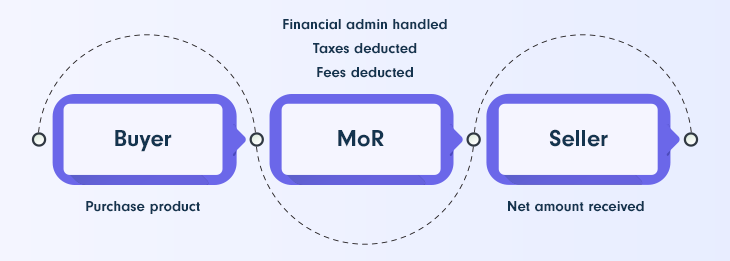
In simple terms, the Merchant of Record is the legal entity financially and legally responsible for a transaction. It is the name that appears on your customer's bank statement, the party responsible for collecting and remitting sales tax, the entity that handles chargebacks, and the one that assumes liability when something goes wrong in the payment chain.
Depending on how your ecommerce business is structured, the Merchant of Record might be you, the platform you sell on, or a specialized third-party provider that absorbs the legal and financial complexity of payment processing on your behalf. The distinction matters because it determines who bears the risk, who handles compliance, and who is ultimately accountable when a customer disputes a charge or a tax authority comes asking.
In this guide, we break down exactly how the Merchant of Record model works, when you need one, and what it means for your ecommerce business in 2026.
Merchant of Record vs Seller of Record: What Is the Difference?
These two terms are frequently used interchangeably and frequently confused even by experienced ecommerce operators. Understanding the distinction between them is essential for structuring your payment infrastructure correctly and knowing exactly where your legal and financial responsibilities begin and end.
What Is a Merchant of Record?
The Merchant of Record is the legal entity that processes the payment transaction. It is the name that appears on the customer's bank statement, the party that holds the merchant account with the payment processor, and the entity that assumes full legal and financial responsibility for the transaction including tax collection and remittance, chargeback liability, payment processing compliance, and fraud management. When a customer disputes a charge with their bank, it is the Merchant of Record who faces the chargeback. When a tax authority audits sales tax collection, it is the Merchant of Record who is accountable.
What Is a Seller of Record?
The Seller of Record is the legal entity recognized as the seller of the product or service for tax and regulatory purposes. In many straightforward ecommerce transactions, the Seller of Record and the Merchant of Record are the same entity the business that owns the product and processes the payment is responsible for both the commercial transaction and its tax implications. But in more complex business models marketplaces, SaaS platforms, digital product distributors these two roles can be separated, with one entity handling the commercial relationship with the customer and another handling the payment processing and tax compliance infrastructure.
When Are They Different?
The practical difference becomes most significant in three scenarios. First, when selling through a marketplace like Amazon or Etsy where the platform typically acts as the Merchant of Record for payment processing while you remain the Seller of Record for product liability. Second, when using a third-party Merchant of Record service like Paddle or FastSpring which assumes both roles entirely, handling payment processing, tax compliance, and chargeback management on your behalf while you focus exclusively on your product and customer experience. Third, when selling internationally where the tax compliance complexity of being your own Merchant of Record across multiple jurisdictions creates a level of regulatory burden that most small and mid-sized ecommerce businesses are not equipped to manage independently.
When Do You Need a Merchant of Record Service?
Not every ecommerce business needs a dedicated Merchant of Record service but there are specific scenarios where the complexity, risk, and compliance burden of managing payment processing independently becomes significant enough to make a third-party MoR solution the most rational and most cost-effective choice.
Selling internationally across multiple tax jurisdictions is the most common trigger for needing a Merchant of Record service. Every country and in the United States, every state has its own sales tax or VAT rules, registration thresholds, filing requirements, and enforcement mechanisms. Managing tax compliance independently across even five or ten markets requires dedicated legal and accounting resources that most small and mid-sized ecommerce businesses do not have. A Merchant of Record service absorbs that entire compliance burden collecting the correct tax in every jurisdiction, remitting it to the appropriate authorities, and assuming the liability if anything goes wrong.
Selling digital products or SaaS subscriptions is a second scenario where MoR services deliver significant value. Digital goods are subject to particularly complex and variable tax treatment across jurisdictions with different VAT rates, different definitions of taxable digital services, and different place-of-supply rules that make independent compliance genuinely complex. Platforms like Paddle and FastSpring were built specifically for this use case and handle the full MoR responsibility for digital product sellers globally.
Managing chargeback risk is a third scenario. If your business operates in a high-chargeback category digital products, subscription services, or high-value physical goods the financial exposure of bearing chargeback liability independently can be significant. A Merchant of Record service absorbs that liability entirely, protecting your merchant account health and your cash flow simultaneously.
If your business is selling in a single market with straightforward physical products and manageable transaction volumes, being your own Merchant of Record is entirely viable. As complexity grows, the case for outsourcing that responsibility strengthens considerably.
FAQ About the Merchant of Record
What is a Merchant of Record in simple terms?
A Merchant of Record is the legal entity that takes financial and legal responsibility for a payment transaction. It is the name that appears on your customer's bank statement, the party responsible for collecting and remitting sales tax, and the entity that handles chargebacks and payment processing compliance. In a direct-to-consumer ecommerce store, you are typically your own Merchant of Record. In a marketplace or managed payment model, a third party assumes that role on your behalf.
What is the difference between a Merchant of Record and a Seller of Record?
The Merchant of Record owns the payment transaction handling processing, tax collection, chargebacks, and compliance. The Seller of Record is the legal entity recognized as the seller of the product for tax and regulatory purposes. In straightforward ecommerce transactions, these roles belong to the same entity. In marketplace and managed payment models, they can be deliberately separated with one party handling the commercial relationship and another handling the payment infrastructure.
Do I need a Merchant of Record service for my ecommerce store?
Not necessarily it depends on your business model, your markets, and your transaction complexity. If you are selling in a single market with straightforward physical products, being your own Merchant of Record is entirely manageable. If you are selling digitally, internationally, or across multiple tax jurisdictions, a third-party Merchant of Record service significantly reduces your compliance burden and liability exposure.
What does a Merchant of Record handle on my behalf?
A Merchant of Record service typically handles payment processing, sales tax and VAT collection and remittance across jurisdictions, chargeback management, fraud prevention, PCI DSS compliance, and currency conversion. The specific scope varies between providers but the core value proposition is absorbing the legal and financial complexity of global payment processing so you can focus on your product and customer experience.
Which platforms act as Merchant of Record?
Several specialized platforms act as Merchant of Record for ecommerce and SaaS businesses including Paddle, FastSpring, and Lemon Squeezy for digital products and software. Major marketplaces like Amazon and Etsy also act as Merchant of Record for transactions processed through their platforms, assuming tax collection and remittance responsibilities on behalf of their sellers.
What happens if my Merchant of Record handles a chargeback incorrectly?
If you are using a third-party Merchant of Record service, the chargeback liability sits with them rather than with you meaning that incorrectly handled disputes affect their merchant account health rather than yours. This is one of the primary financial risk management advantages of using a MoR service, particularly for businesses in high-chargeback product categories or subscription models where dispute rates tend to be higher than average.
Is being your own Merchant of Record risky?
It carries specific risks that are manageable when your business is operating in a single market at moderate transaction volumes but that grow significantly as you expand internationally, increase your transaction volume, or add complexity through subscriptions, digital products, or high-value goods. The primary risks are tax compliance liability across jurisdictions, chargeback exposure on your merchant account, and the operational cost of managing payment processing compliance independently.
How does a Merchant of Record handle international sales tax?
A Merchant of Record service monitors the tax registration thresholds, rates, and filing requirements for every jurisdiction where your customers are located collecting the correct tax at the point of sale, remitting it to the appropriate authorities on the required schedule, and assuming the liability if any compliance issue arises. This is the single most commercially significant benefit of using a MoR service for businesses selling internationally, as independent tax compliance across multiple jurisdictions requires dedicated legal and accounting resources that most ecommerce businesses cannot justify at early and mid-stage growth.
Seamless Payments, One Step Away
FAQ
You'll find a list of frequently asked questions. Should you have any additional queries, don't hesitate to contact us. We're here to help!
Simple, transparent pricing with no hidden fees. Check out our pricing page for the full breakdown.
Spoiler: low fees all-in with no surprises.
Years ago, selling internationally was complex and expensive. Today, with AI translation and social media, businesses launch globally without even realizing it. Then MoRs (Merchants of Record) arrived promising easy global payments, but with brutal terms: 10%+ fees, terrible acceptance rates, unoptimized checkouts, and random account blocks. It worked for some, but limited many more.
With Inflow, you're global from day one with best-in-class terms from the start: transparent pricing, highest acceptance rates, and zero risk of sudden suspensions.
Absolutely. We handle the entire migration, your customers won't even notice the switch. Zero downtime, zero disruption, and your recurring revenue keeps flowing uninterrupted.
Make the world your market.
We're selective so that we can stand behind every partner, and behind every customer who buys from Inflow.