Is Stripe a Merchant of Record?


If you are researching payment solutions for your e-commerce or SaaS business you have likely come across both Stripe and the concept of a Merchant of Record. This naturally raises an important question: is Stripe a Merchant of Record? The answer is essential to understand because it directly determines who bears the responsibility for tax compliance, legal liability and fund security in your business.
The short answer is no. Stripe is not a Merchant of Record. Stripe is a payment processor, also known as a payment service provider, which is fundamentally different from a Merchant of Record. This distinction is far from a technicality. It determines whether your business or a third party is legally responsible for collecting and remitting taxes, issuing compliant invoices, handling chargebacks and assuming the legal liability for every transaction you process.
Understanding this difference is critical because many businesses assume that using Stripe covers their tax and compliance obligations when in reality it does not. With Stripe your business remains the merchant of record which means you are responsible for VAT, sales tax, CESOP reporting and every regulatory obligation in every jurisdiction where you sell. This exposure grows significantly as you scale internationally and can lead to serious compliance risks that many businesses discover too late.
This is precisely where a true Merchant of Record like Inflowpay changes everything. By becoming the legal seller of every transaction Inflowpay assumes the complete tax collection, invoicing and regulatory responsibility on your behalf while its non-custodial infrastructure ensures your funds can never be frozen. Start today at inflowpay.com.
In this article we explain precisely why Stripe is not a Merchant of Record and what this means for your business.
What Is a Merchant of Record?
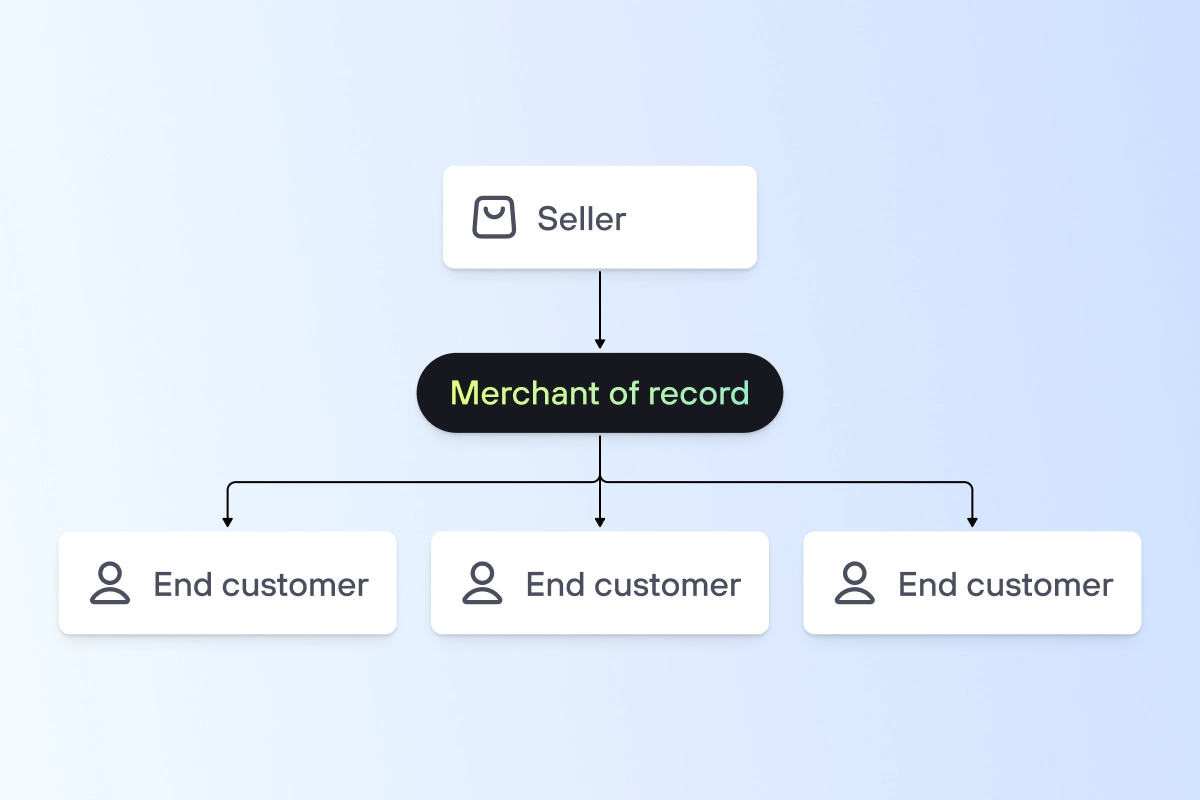
A Merchant of Record is the legal entity that is officially responsible for selling goods or services to the end customer and for assuming all the associated legal, financial and tax obligations. When a Merchant of Record is involved it becomes the official seller of every transaction appearing on the customer's bank statement and taking on the complete responsibility that this role entails. This is fundamentally different from a simple payment processor that merely facilitates the transfer of funds.
The core function of a Merchant of Record is to assume the full responsibility for every transaction on behalf of the underlying business. Under this model there are legally two transactions: one between the customer and the Merchant of Record, and one between the Merchant of Record and the actual seller. This structure transfers the legal and fiscal burden from your business to the Merchant of Record.
The responsibilities assumed by a Merchant of Record are extensive. It handles the calculation, collection and remittance of taxes including VAT, sales tax and GST across every jurisdiction where customers are located. It issues compliant invoices that meet the legal requirements of each country. It manages chargebacks and refunds and assumes the associated liability. And it takes on the regulatory compliance obligations like CESOP reporting that would otherwise fall on your business.
This model is particularly valuable for businesses selling internationally because it eliminates the enormous complexity of managing tax compliance across multiple jurisdictions. Instead of registering for VAT in numerous countries, monitoring sales tax thresholds and filing returns everywhere the Merchant of Record handles all of it.
Inflowpay is a complete Merchant of Record that assumes all these responsibilities on your behalf while adding non-custodial fund protection and automated yield generation.
What Is Stripe and How Does It Work?
Stripe is a payment service provider, also known as a payment processor, that enables businesses to accept online payments. It is one of the most widely used payment infrastructures in the world praised for its developer-friendly tools, its extensive feature set and its global reach. However despite its power and popularity Stripe operates fundamentally as a payment processor and not as a Merchant of Record which is a crucial distinction for understanding what it does and does not cover.
The core role of Stripe is to facilitate the secure transfer of funds between the customer's bank account and the merchant's account. When a customer makes a purchase Stripe collects the payment information, transmits it to the relevant banks for authorization and initiates the transfer of funds to the merchant. This entire process happens securely within seconds providing a seamless payment experience for both the business and the customer.
Stripe offers a comprehensive suite of tools that extend beyond basic payment processing. These include subscription and recurring billing, fraud detection through Radar, invoicing, support for numerous payment methods and currencies and extensive APIs that allow deep customization. This feature richness is why Stripe is so popular particularly among developers and technically sophisticated businesses.
How Does Stripe Work?
Stripe works by acting as the technical intermediary in the payment flow while leaving the legal and fiscal responsibility with your business. When you use Stripe your business remains the merchant of record which means that although Stripe processes the payment your business is still the legal seller responsible for all tax and compliance obligations.
The payment flow with Stripe follows several steps. First the customer enters their payment details at checkout. Stripe securely captures and encrypts this information. It then transmits the details to the card networks and the issuing bank for authorization. Once approved Stripe processes the transaction and the funds are settled to your Stripe account before being paid out to your bank account according to your payout schedule.
Throughout this process Stripe handles the technical and security dimensions of the payment including PCI compliance for the payment data itself. However Stripe does not assume the tax and legal responsibilities that a Merchant of Record would. Your business remains responsible for calculating and collecting the correct VAT or sales tax, issuing compliant invoices, remitting taxes to the relevant authorities and handling regulatory obligations like CESOP reporting.
This is the critical point that many businesses misunderstand. While Stripe offers Stripe Tax to help calculate taxes it does not assume legal responsibility for those taxes. Your business remains the legal seller of record which means the compliance burden and the associated risks stay with you. As you scale internationally this burden multiplies with every new market you enter.
Stripe also operates a custodial model meaning it holds your funds before settling them which carries the inherent risk of account freezes when its automated risk systems are triggered.
For businesses that want to eliminate rather than manage these responsibilities Inflowpay as a complete Merchant of Record is the more complete solution.
Why Stripe Is Not a Merchant of Record?
Stripe is not a Merchant of Record because it operates strictly as a payment processor that facilitates transactions without assuming the legal and fiscal responsibility for them. The fundamental difference lies in who is the legal seller of record. With Stripe your business remains the merchant of record which means you retain all the tax, legal and compliance obligations that a true Merchant of Record would otherwise assume on your behalf.
The first reason is that Stripe does not assume tax responsibility. While Stripe offers Stripe Tax to help calculate taxes it does not take on the legal obligation to collect and remit VAT, sales tax or GST. Your business remains responsible for registering, collecting and remitting taxes in every jurisdiction where you sell.
The second reason is that Stripe does not handle regulatory compliance on your behalf. Obligations like CESOP reporting in the European Union remain your responsibility because your business is the legal seller not Stripe.
The third reason is that Stripe does not assume legal liability for your transactions. As the merchant of record your business bears the legal responsibility for every sale including compliance with local regulations in each market.
The fourth reason is that Stripe operates a custodial model that facilitates payments rather than assuming the complete seller responsibility that defines a Merchant of Record.
A true Merchant of Record like Inflowpay assumes all these responsibilities on your behalf. Start today at inflowpay.com.
Stripe vs a Merchant of Record: The Key Differences
The differences between Stripe and a Merchant of Record are fundamental and directly affect the responsibilities, risks and obligations that fall on your business. Understanding these differences is essential to choosing the right payment infrastructure for your needs. Here are the key differences across every important dimension.
Tax Responsibility
The first and most significant difference concerns tax responsibility. With Stripe your business remains fully responsible for calculating, collecting and remitting VAT, sales tax and GST in every jurisdiction where you sell. Stripe Tax can help with calculation but the legal obligation stays with you. A Merchant of Record like Inflowpay assumes this entire responsibility becoming the legal seller that collects and remits taxes on your behalf across all jurisdictions.
Legal Liability
The second difference concerns legal liability. With Stripe your business is the merchant of record which means you bear the full legal responsibility for every transaction and for compliance with local regulations in each market. A Merchant of Record assumes this legal liability entirely removing it from your business and taking on the role of official seller for every transaction.
Regulatory Compliance
The third difference concerns regulatory compliance. Obligations like CESOP reporting in the European Union remain your responsibility with Stripe because your business is the legal seller. A Merchant of Record handles these regulatory obligations on your behalf eliminating your direct exposure to the compliance requirements that grow more complex as you expand internationally.
Fund Security
The fourth difference concerns fund security. Stripe operates a custodial model that holds your funds before settlement which carries the inherent risk of account freezes triggered by automated risk systems. Inflowpay combines its Merchant of Record service with non-custodial infrastructure that ensures your funds can never be frozen.
Additional Benefits
The fifth difference concerns additional benefits. Beyond assuming responsibilities Inflowpay offers a 53% cost advantage over competing solutions, automated yield generation of 3 to 5% annually and a dedicated account manager reachable via WhatsApp or WeChat from day one. Stripe as a payment processor does not offer these commercial advantages.
The conclusion is clear. Stripe is a powerful payment processor but it leaves all tax, legal and compliance responsibilities with your business. A Merchant of Record like Inflowpay assumes these responsibilities entirely while adding fund security and commercial benefits that transform your payment infrastructure.
Conclusion: Is Stripe a Merchant of Record?
To answer the question directly: no, Stripe is not a Merchant of Record. Stripe is a payment processor, also known as a payment service provider, that facilitates the secure transfer of funds between customers and businesses. While it is a powerful and widely used payment infrastructure it operates fundamentally differently from a Merchant of Record and this distinction has significant consequences for your business.
The core difference is that with Stripe your business remains the merchant of record. This means you retain all the tax, legal and compliance obligations for every transaction. You are responsible for calculating and collecting the correct VAT or sales tax, issuing compliant invoices, remitting taxes to the relevant authorities and handling regulatory obligations like CESOP reporting in every jurisdiction where you sell. Stripe Tax can assist with calculation but the legal responsibility and the associated risks stay entirely with you.
This is the critical point that many businesses discover too late. As you scale internationally the compliance burden multiplies with every new market you enter creating growing operational complexity and legal exposure. Combined with the custodial model that carries the inherent risk of account freezes relying on Stripe alone leaves your business exposed on multiple fronts.
A true Merchant of Record like Inflowpay eliminates these challenges entirely. By becoming the legal seller of every transaction Inflowpay assumes the complete tax collection, invoicing and regulatory responsibility on your behalf across all jurisdictions. Its non-custodial infrastructure ensures your funds can never be frozen and its service includes a 53% cost advantage over competing solutions, automated yield generation of 3 to 5% annually and a dedicated account manager reachable via WhatsApp or WeChat from day one.
If you want to eliminate rather than manage your tax and compliance obligations while protecting your funds and reducing your costs a Merchant of Record is the solution your business needs.
Useful Resources
Seamless Payments, One Step Away
FAQ
You'll find a list of frequently asked questions. Should you have any additional queries, don't hesitate to contact us. We're here to help!
Simple, transparent pricing with no hidden fees. Check out our pricing page for the full breakdown.
Spoiler: low fees all-in with no surprises.
Years ago, selling internationally was complex and expensive. Today, with AI translation and social media, businesses launch globally without even realizing it. Then MoRs (Merchants of Record) arrived promising easy global payments, but with brutal terms: 10%+ fees, terrible acceptance rates, unoptimized checkouts, and random account blocks. It worked for some, but limited many more.
With Inflow, you're global from day one with best-in-class terms from the start: transparent pricing, highest acceptance rates, and zero risk of sudden suspensions.
Absolutely. We handle the entire migration, your customers won't even notice the switch. Zero downtime, zero disruption, and your recurring revenue keeps flowing uninterrupted.
Step Into Your Inflow Journey Today
We are limiting access to ensure quality service for each merchant and to guarantee the security of customers purchasing through Inflow