What Is a PayFac vs Payment Processor?

If you have ever compared payment providers you have probably encountered both terms without a clear sense of what separates them. The distinction matters more than it appears because it determines your onboarding speed, your fees, your level of control and crucially how exposed you are to having your funds frozen. So what is a PayFac versus a payment processor and which model actually fits your business?
A payment processor is the infrastructure that moves money between the customer's bank, the card networks and your account. Working directly with one typically means obtaining your own merchant account which requires a full underwriting process, financial documentation and often several weeks of approval. In exchange you get your own merchant identification number, direct relationships and generally better rates at volume.
A payment facilitator, commonly shortened to PayFac, sits on top of that infrastructure. It holds a single master merchant account and onboards you as a sub-merchant underneath it. This is why platforms like Stripe, Square and PayPal approve you in minutes rather than weeks. You share their infrastructure which removes the underwriting friction entirely.
That convenience carries a real trade-off. Because you operate under someone else's merchant account the PayFac assumes your risk which means it can freeze your funds or terminate your account without warning when something triggers their risk model. Thousands of merchants discover this only when it happens. Fees are also typically higher since the PayFac absorbs that liability.
Neither model handles your tax compliance however. VAT and sales tax remain entirely your responsibility with both which is a third category most comparisons ignore.
This is where Inflowpay available at inflowpay.com operates differently as a Merchant of Record with non custodial fund protection, full tax compliance and fees up to 53% cheaper.
In this article we explain the difference between a PayFac and a payment processor.
What Is a Payment Processor?
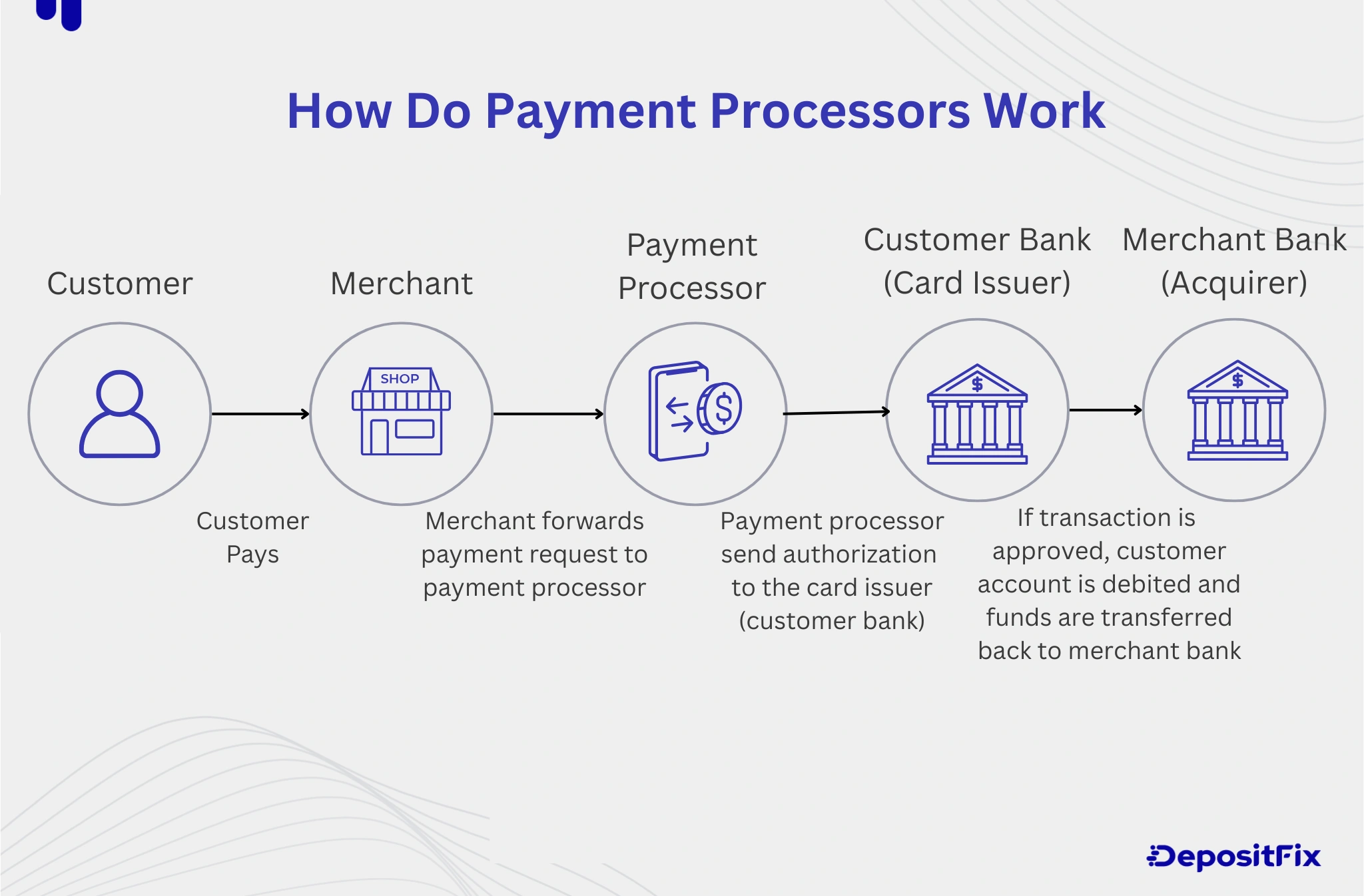
A payment processor is the company that handles the technical movement of money between your customer's bank, the card networks and your business account. When someone pays on your store the processor transmits the transaction data to the card network, receives the authorization decision from the issuing bank and then settles the funds. It is the infrastructure layer that makes card payments work.
Working directly with a processor generally means obtaining your own merchant account. This is a specific type of bank account that holds funds before they settle into your business account, and getting one requires going through underwriting. The acquiring bank examines your business model, your financial history, your projected volumes and your risk category before approving you. This process typically takes several days to several weeks and requires substantial documentation.
That friction buys you real advantages. You receive your own merchant identification number which means your business is known and assessed individually by the acquiring bank rather than lumped into a shared pool. You gain a direct relationship which matters when something goes wrong. And critically your account cannot be terminated because of another merchant's behavior.
The pricing structure also differs. Direct processing typically uses interchange-plus pricing where you pay the actual interchange cost set by the card networks plus a transparent markup. At volume this is significantly cheaper than the flat rates PayFacs charge since you are not subsidizing the risk of thousands of other merchants.
Stability is the other major benefit. Because you were underwritten individually and the acquirer understands your business the likelihood of sudden account termination or fund freezing is far lower. Your risk profile was assessed upfront rather than reactively.
The trade-off is complexity and time. Setup is slower, technical integration often requires developer resources and minimum volume requirements exclude smaller businesses entirely.
Note that a payment processor handles money movement only. Tax compliance remains entirely yours which is where Inflowpay available at inflowpay.com takes a different approach.
What Is a Payment Facilitator (PayFac)?
A payment facilitator, commonly shortened to PayFac, is a company that holds a single master merchant account and onboards businesses underneath it as sub-merchants. Rather than each merchant obtaining their own account through underwriting they operate within the PayFac's existing infrastructure. Stripe, Square and PayPal are the most recognizable examples of this model.
The defining advantage is speed of onboarding. Because you are not going through individual underwriting you can create an account and start accepting payments within minutes. There is no financial documentation to submit, no acquiring bank to convince and no waiting period. For a business launching quickly or testing a market this removes an enormous barrier to entry.
The second advantage is simplicity. PayFacs handle the technical complexity behind the scenes and typically provide clean APIs, ready-made integrations with e-commerce platforms and straightforward dashboards. You get a working payment setup without needing to understand acquiring relationships or interchange structures.
Pricing follows a flat-rate model which is predictable and easy to understand. A typical PayFac charges something like 2.9% plus a fixed amount per transaction regardless of card type. For low-volume businesses this simplicity often works out cheaper than the fixed costs attached to a dedicated merchant account.
The trade-off however is significant and frequently underestimated. Because you operate under the PayFac's merchant account the PayFac carries your risk. This means it can freeze your funds, hold your payouts or terminate your account without warning when its risk model flags something unusual. Sudden volume spikes, chargeback increases or simply entering a category it deems risky can trigger this. Thousands of merchants discover this only when their revenue stops.
You also have less control and less negotiating power. Rates are standardized, you have no direct acquirer relationship and support is typically handled through generic channels.
PayFac vs Payment Processor: What Are the Key Differences?
Both models let you accept card payments but they differ fundamentally in how risk, control and cost are distributed. Here are the key differences between a PayFac and a payment processor.
Merchant account structure
The foundational difference is who owns the merchant account. With a payment processor you obtain your own merchant account and your own merchant identification number which means the acquiring bank knows and assesses your business individually. With a PayFac you operate as a sub-merchant under their master account sharing infrastructure with thousands of other businesses. Every other difference flows from this single structural distinction.
Onboarding and approval time
The most visible difference is speed. A PayFac approves you in minutes since no individual underwriting takes place. A direct processor requires full underwriting including financial documentation, business model review and risk assessment which typically takes days or weeks. This gap explains why most businesses start with a PayFac regardless of their long-term plans.
Pricing model
The pricing structures diverge significantly. PayFacs charge flat rates such as 2.9% plus a fixed fee regardless of card type. Processors typically use interchange-plus pricing where you pay the actual network cost plus a transparent markup. Flat rates are simpler and often cheaper at low volume while interchange-plus becomes markedly cheaper as your processing grows.
Risk exposure and account stability
This is the difference that costs businesses the most. With a PayFac your funds can be frozen or your account terminated without warning because the PayFac carries your risk and protects itself accordingly. With your own merchant account you were underwritten individually which makes sudden termination far less likely. Many merchants only discover this distinction when their payouts stop.
Control and relationships
A processor gives you a direct acquiring relationship, negotiating leverage and dedicated support. A PayFac offers standardized terms and generic support channels with limited room to negotiate.
Which Model Should You Choose for Your Business?
The right choice depends primarily on your volume, your risk profile and how much control you actually need.
Choose a PayFac if you are launching or operating at modest volume. Getting approved in minutes rather than weeks matters enormously when you are validating a product and cannot afford to wait. Flat-rate pricing is also genuinely cheaper below a certain threshold since dedicated merchant accounts carry fixed costs that outweigh the rate difference at low volume. For a business processing a few thousand euros monthly the simplicity is worth the trade-offs.
Choose a direct payment processor once your volume justifies the complexity. The threshold varies but interchange-plus pricing typically becomes advantageous somewhere above 20,000 to 50,000 euros in monthly processing. At that scale the rate difference translates into thousands of euros annually. More importantly you gain account stability which becomes critical once your business genuinely depends on uninterrupted revenue. Being underwritten individually means an algorithm cannot decide overnight that your account looks suspicious.
There is however a third consideration most comparisons ignore entirely. Both models handle money movement and nothing else. If you sell internationally your VAT and sales tax obligations remain fully yours regardless of which you pick. That means registrations across jurisdictions, threshold monitoring, filings and potentially fiscal representatives. This carries a real cost that never appears in any processing rate comparison.
The fund freezing risk also deserves more weight than it usually receives. A frozen account does not simply delay revenue, it halts operations while your advertising spend continues running and your suppliers still expect payment. For businesses with thin cash reserves this single event can be terminal.
This is precisely why the Merchant of Record model exists as a third path. Inflowpay available at inflowpay.com combines payment acceptance with full tax compliance across all jurisdictions, non custodial fund protection that structurally prevents freezing, onboarding in under 24 hours and fees up to 53% cheaper than competitors.
How Does a Merchant of Record Differ From Both?
A Merchant of Record operates on a fundamentally different principle. Where processors and PayFacs move money on your behalf a Merchant of Record becomes the legal seller of your transactions. This single distinction changes who carries the tax obligation, who assumes the liability and whose name appears on the customer's bank statement.
The decisive difference is tax compliance. Both processors and PayFacs leave VAT and sales tax entirely to you. That means registering in each jurisdiction where you cross a threshold, monitoring those thresholds continuously, filing returns on different schedules and potentially appointing fiscal representatives in countries where you are not established. A Merchant of Record absorbs all of it because it is the legal seller and therefore the party legally obligated. This is not a convenience feature but a transfer of responsibility.
The second major difference is liability. Chargebacks, fraud exposure and regulatory obligations such as OSS, IOSS and CESOP reporting fall on the provider rather than on you. If a tax authority raises a question about a transaction the Merchant of Record is the responsible party. This transfer is precisely what businesses pay for and it does not exist in either of the other two models.
The third difference is fund security. With a PayFac your account can be frozen overnight because you operate under their merchant account and their risk model protects them rather than you. Inflowpay specifically uses a non custodial model which structurally prevents your funds from being frozen. This addresses the single largest weakness of the PayFac approach.
The fourth difference is speed without the trade-off. A processor takes weeks to underwrite you while a PayFac approves you instantly but exposes you to termination. A Merchant of Record like Inflowpay onboards you in under 24 hours while carrying the compliance and liability itself.
Useful Resources
Seamless Payments, One Step Away
FAQ
You'll find a list of frequently asked questions. Should you have any additional queries, don't hesitate to contact us. We're here to help!
Simple, transparent pricing with no hidden fees. Check out our pricing page for the full breakdown.
Spoiler: low fees all-in with no surprises.
Years ago, selling internationally was complex and expensive. Today, with AI translation and social media, businesses launch globally without even realizing it. Then MoRs (Merchants of Record) arrived promising easy global payments, but with brutal terms: 10%+ fees, terrible acceptance rates, unoptimized checkouts, and random account blocks. It worked for some, but limited many more.
With Inflow, you're global from day one with best-in-class terms from the start: transparent pricing, highest acceptance rates, and zero risk of sudden suspensions.
Absolutely. We handle the entire migration, your customers won't even notice the switch. Zero downtime, zero disruption, and your recurring revenue keeps flowing uninterrupted.
Make the world your market.
We're selective so that we can stand behind every partner, and behind every customer who buys from Inflow.