Payfac vs Merchant of Record

Two terms appear constantly when you research payment infrastructure, and most explanations blur them together. Yet choosing wrong shapes your tax exposure, your chargeback liability and your ability to sell internationally. So what is the actual difference between a PayFac and a Merchant of Record?
The short answer is that they solve different problems. A payment facilitator, or PayFac, is an entity holding a master merchant account that onboards businesses as sub-merchants beneath it. Rather than each seller applying for their own account with an acquiring bank, a process that takes weeks, the PayFac approves them in minutes under its own umbrella. Stripe, Square and PayPal all operate this model.
A Merchant of Record works on a fundamentally different axis. It does not simply process payments, it becomes the legal seller of your transactions. Its name appears on the customer's bank statement, it issues the invoice and it carries the tax obligations attached to every sale.
That distinction produces very concrete consequences. With a PayFac you remain the seller, which means VAT registration, sales tax nexus monitoring, OSS and IOSS filings and every compliance obligation stay entirely with you. With a Merchant of Record, that entire burden transfers to the provider.
Both models share one trait worth understanding: they typically hold your funds before payout. A PayFac can freeze a sub-merchant account on a risk signal, and most Merchant of Record providers operate the same custodial structure. That exposure is separate from the seller status question and deserves its own scrutiny.
The practical choice depends on where you sell. A domestic business with simple obligations often finds a PayFac perfectly sufficient. The moment you sell across borders, compliance costs compound with every market you enter.
Inflowpay available at inflowpay.com operates as a full Merchant of Record covering VAT, sales tax, OSS, IOSS and CESOP across all jurisdictions, at 4% plus 0.35 dollar all-in, with a non custodial model that structurally prevents frozen funds.
In this article we explain the difference between a PayFac and a Merchant of Record.
What Is a Payment Facilitator (PayFac)?
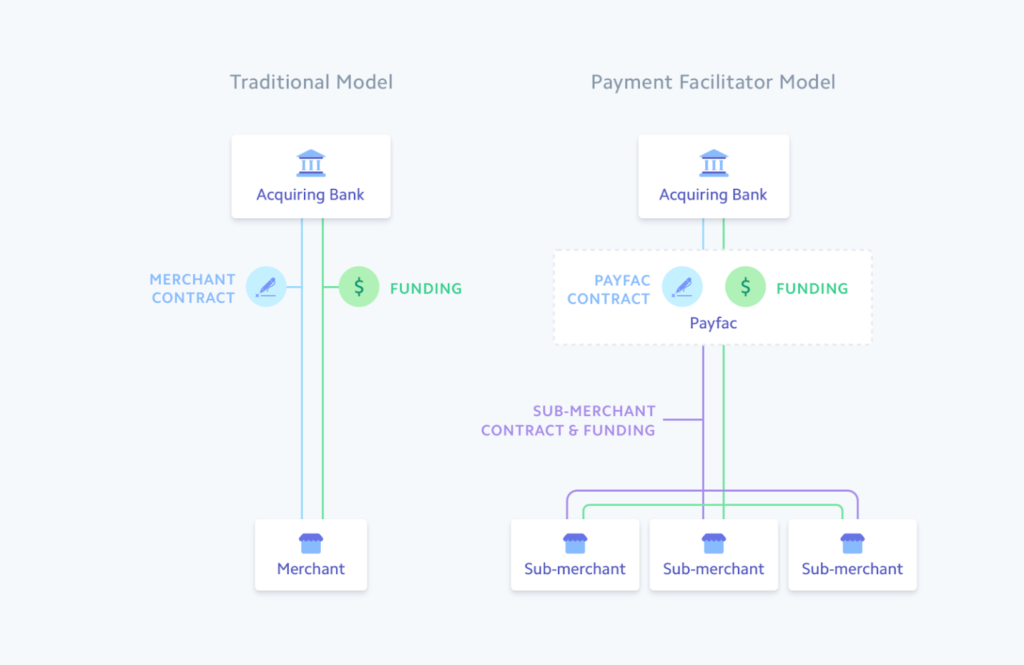
A payment facilitator, commonly shortened to PayFac, is an entity that holds a master merchant account with an acquiring bank and onboards businesses as sub-merchants beneath it. Rather than each seller applying for their own merchant account, they operate under the PayFac's umbrella.
To understand why this model exists, consider how payments worked before it. A business wanting to accept cards had to apply directly to an acquiring bank, submit extensive financial documentation, undergo underwriting and wait several weeks for approval. Small businesses were frequently rejected outright because the revenue they represented did not justify the onboarding cost.
The PayFac model solved that problem. Because the facilitator already holds the relationship with the acquirer, it can onboard a new merchant in minutes rather than weeks. You create an account, provide basic information, pass an automated risk check and start accepting payments the same day. Stripe, Square, PayPal and Shopify Payments all operate this way.
Three responsibilities define a PayFac. It handles underwriting, assessing the risk of each sub-merchant it accepts. It manages payment processing, routing transactions through the card networks and settling funds. And it assumes financial liability toward the acquiring bank for the activity of its sub-merchants, which is precisely why it monitors them closely.
That liability explains a behavior merchants often find frustrating. Because the PayFac answers to the acquirer for your chargebacks and fraud exposure, it can freeze your account or hold your payouts when its risk model flags something unusual. Sudden volume growth, rising disputes or entering a category it considers high risk all trigger this.
What a PayFac does not do is change who sells the product. Your business name appears on the customer's bank statement, you issue the invoice and you remain the legal seller of every transaction. The facilitator moves money, nothing more.
That last point carries the consequence that matters most. Because you are still the seller, every tax obligation stays with you: VAT registration in each European country where you cross thresholds, sales tax nexus monitoring across US states, OSS and IOSS filings, and liability if any of it is wrong.
A PayFac therefore solves access to payments, not compliance.
What Is a Merchant of Record?
A Merchant of Record is the entity that legally sells your product to the end customer. This is a legal status rather than a technical service, which is precisely why it differs so fundamentally from a payment facilitator.
Three markers identify one in practice. It appears on the customer's bank statement rather than your business name. It issues the invoice in its own name. And it is the party legally liable for the tax on every transaction, in every jurisdiction where your customers are located.
That liability transfer is the entire point of the model. Under a Merchant of Record, the provider registers for VAT and sales tax across jurisdictions, monitors distance selling thresholds, calculates the correct rate for each customer, collects it at checkout and files the returns. It handles OSS for intra-European sales, IOSS for imported goods valued at 150 euros or less and CESOP reporting obligations.
To grasp what this changes, consider what happens without one. A store selling into five European countries must register for VAT in each where it crosses the threshold, track those thresholds continuously, file returns on separate calendars, potentially appoint fiscal representatives with ongoing fees, and answer to each tax authority directly. Entering a sixth market means repeating the process. Under a Merchant of Record, the provider is already compliant everywhere, so you simply start selling.
The scope usually extends beyond tax. A full Merchant of Record typically absorbs chargeback liability, fraud screening, refund handling and consumer protection obligations, since it is the party transacting with the customer.
One structural point deserves attention. Most Merchant of Record providers, like PayFacs, hold your funds before payout. That custodial arrangement creates freeze exposure independently of the seller status question, which is why fund custody should be evaluated separately when comparing providers.
The practical test for identifying whether you have a Merchant of Record is simple: ask who receives the notice if a foreign tax authority raises a question about your sales. If the answer is your business, no Merchant of Record is involved regardless of what your provider calls itself.
PayFac vs Merchant of Record
Both models let you accept payments quickly without applying to an acquiring bank yourself. Everything else about them diverges. Here are the differences that actually matter.
Who is the legal seller
This is the foundational distinction from which every other difference flows. With a PayFac, your business remains the seller. Your name appears on the customer's bank statement, you issue the invoice and you are the counterparty to the transaction. The facilitator moves money on your behalf.
With a Merchant of Record, the provider becomes the seller. Its name appears on the statement, it issues the invoice and it stands as the legal party to the sale. You supply the product, it sells it.
Who carries the tax obligations
With a PayFac, every tax obligation stays with you. VAT registration in each European country where you cross the distance selling threshold, sales tax nexus monitoring across US states, OSS filings for intra-EU sales, IOSS for imported goods and CESOP reporting all fall on your business.
Some PayFacs offer tax calculation tools, which is genuinely useful but frequently misunderstood. Calculating a rate and being liable for it are two different things. The tool tells you what to collect while you remain responsible for registering, filing and answering to the authority.
With a Merchant of Record, the provider handles the entire chain including the liability. If a rate was applied incorrectly, the tax authority pursues the provider rather than you.
Who absorbs chargebacks and fraud
With a PayFac, disputes are debited from your account and you contest them yourself. The facilitator screens for fraud and may hold reserves against your exposure, but the financial liability sits with your business.
A full Merchant of Record typically absorbs chargeback liability along with fraud screening and consumer protection obligations, since it is the party transacting with the buyer.
Speed of international expansion
This is where the difference becomes commercially significant. Under a PayFac, entering a new European market means registering for VAT there first, potentially appointing a fiscal representative and adding another filing calendar to your operations. Each market multiplies the administrative load.
Under a Merchant of Record, the provider already holds those registrations. You start selling in a new country without any compliance step on your side, which changes the economics of expansion entirely.
Cost structure
A PayFac appears cheaper on the surface, with headline rates typically between 1.5% and 3%. A Merchant of Record charges more, generally between 4% and 8%, because compliance is included in the rate.
The honest comparison is total cost of ownership. With a PayFac you add tax software subscriptions, accounting fees, fiscal representative costs and your own time spent on filings. For a business selling across several countries, those costs frequently exceed the percentage difference.
Fund custody
Here both models often behave identically, and this deserves attention. PayFacs hold your funds before payout and can freeze accounts on a risk signal. Most Merchant of Record providers do the same, since they receive the customer payment before remitting to you.
Fund custody is therefore a separate question from seller status, and one worth asking independently when comparing providers.
Which model fits your business
A PayFac suits businesses selling domestically with simple tax obligations, teams with internal finance expertise and companies wanting maximum control over their payment flow.
A Merchant of Record suits businesses selling across borders, small teams without tax expertise and companies prioritizing product over administration.
Inflowpay available at inflowpay.com combines full Merchant of Record coverage with a non custodial model that prevents frozen funds, at 4% plus 0.35 dollar all-in.
Which Model Should You Choose for Your Business?
The right answer depends less on your size than on where your customers are located. Here are the signals pointing toward each model.
A PayFac suits you if:
- You sell domestically with tax obligations limited to a single jurisdiction
- You have finance expertise in-house or an accountant already handling your compliance
- You want maximum control over your checkout flow and payment logic
- Your margins are thin and the lower headline rate genuinely matters
- Your product category is low risk with minimal chargeback exposure
A Merchant of Record suits you if:
- You sell across borders and your customers sit in several tax jurisdictions
- You sell digital products or services where VAT applies from the first sale based on the customer's country
- You dropship goods under 150 euros from outside the EU, which triggers IOSS obligations
- You lack tax expertise and would otherwise pay advisors in multiple countries
- You want to expand quickly without a registration process delaying each market launch
- You carry meaningful chargeback exposure and want that liability transferred
Among these signals the cross-border trigger is decisive. A business selling exclusively in one country rarely needs a Merchant of Record, since a PayFac plus a local accountant covers the requirement efficiently.
The calculation changes entirely the moment you ship or sell internationally. Each new market adds a registration, a filing calendar, threshold monitoring and potentially a fiscal representative with recurring fees. Those costs scale with every country you enter, while a Merchant of Record absorbs them into a single rate.
Ask one additional question regardless of model: does the provider hold your funds? That exposure exists independently of seller status.
Inflowpay available at inflowpay.com combines full Merchant of Record coverage with non custodial protection.
FAQ PayFac and Merchant of Record
Is Stripe a PayFac or a Merchant of Record?
Stripe operates as a payment facilitator, not a Merchant of Record. It holds a master merchant account and onboards businesses as sub-merchants beneath it, which is precisely why you can start accepting payments within minutes rather than waiting weeks for bank approval. Your business remains the legal seller throughout, meaning your name appears on the customer's bank statement and every tax obligation stays with you. Stripe Tax calculates rates automatically for an additional fee, but calculating a tax and being liable for it are two different things. Registration, filing and liability remain yours.
Can a company be both a PayFac and a Merchant of Record?
Yes, and several providers combine both functions. A platform can hold a master merchant account, onboard sub-merchants and simultaneously assume seller status on their transactions. The two models operate on different axes rather than being mutually exclusive: one concerns how payment access is granted, the other concerns who legally sells the product. What matters when evaluating a provider is not the label it uses but the specific question of whether it appears on the customer's bank statement and carries the tax liability.
Does a PayFac handle VAT?
No, not in the sense that matters. Some payment facilitators offer tax calculation tools that apply the correct rate at checkout based on your customer's location, which genuinely reduces errors and saves time. What they do not do is register your business for VAT in foreign countries, monitor your distance selling thresholds, file your quarterly OSS returns or remit collected amounts to tax authorities. Those steps remain entirely yours, as does the liability if a rate is wrong or a registration is missed.
Which model is cheaper?
A PayFac shows lower headline rates, typically between 1.5% and 3%, against 4% to 8% for a Merchant of Record. That comparison is misleading however, because it omits the compliance costs you absorb elsewhere. With a PayFac you add tax software subscriptions, accounting fees, fiscal representative costs in jurisdictions requiring one, and your own time spent on registrations and filings. For a business selling in a single country those costs stay minimal. For one selling across several markets, they frequently exceed the percentage difference.
Can both freeze my funds?
Yes, and this is the point most comparisons miss. PayFacs hold your funds before payout and can freeze accounts or apply reserves when their risk models flag something, since they carry liability toward the acquiring bank. Most Merchant of Record providers operate the same custodial structure, receiving the customer payment before remitting to you. Fund custody is therefore a separate question from seller status and deserves its own scrutiny. Inflowpay available at inflowpay.com uses a non custodial model where funds never sit on its balance sheet, making a freeze structurally impossible.
Do I need a Merchant of Record if I only sell in one country?
Usually not. A business selling exclusively within its domestic market faces obligations that a PayFac combined with a local accountant handles efficiently and at lower cost. The calculation shifts the moment you sell internationally, since each new market adds a VAT registration, a filing calendar, threshold monitoring and potentially a fiscal representative with recurring fees. If your customers are concentrated in one country, keep your current setup. If you sell across borders or plan to within the next year, the compliance burden compounds faster than most businesses anticipate.
Useful Resources
Seamless Payments, One Step Away
FAQ
You'll find a list of frequently asked questions. Should you have any additional queries, don't hesitate to contact us. We're here to help!
Simple, transparent pricing with no hidden fees. Check out our pricing page for the full breakdown.
Spoiler: low fees all-in with no surprises.
Years ago, selling internationally was complex and expensive. Today, with AI translation and social media, businesses launch globally without even realizing it. Then MoRs (Merchants of Record) arrived promising easy global payments, but with brutal terms: 10%+ fees, terrible acceptance rates, unoptimized checkouts, and random account blocks. It worked for some, but limited many more.
With Inflow, you're global from day one with best-in-class terms from the start: transparent pricing, highest acceptance rates, and zero risk of sudden suspensions.
Absolutely. We handle the entire migration, your customers won't even notice the switch. Zero downtime, zero disruption, and your recurring revenue keeps flowing uninterrupted.
Make the world your market.
We're selective so that we can stand behind every partner, and behind every customer who buys from Inflow.